
Wow Place #356: Shimabara, Japan
When it comes to reputation, there are places that come close to meeting the hype, places that live up to the hype, and places that exceed the hype.
Shimabara is not one of these places.
Nicknamed the “City of Water,” the castle town of Shimabara in Nagasaki Prefecture is renowned for many things: its samurai-era historical district; its reconstructed, five-story castle; its regionally-famous kanzarashi sweets (a traditional dessert of small rice-flour dumplings served in chilled, spring-water syrup), to name a few.
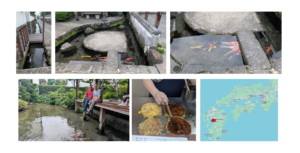
The reason I changed my itinerary to come here, however, was to see the drainage ditches. You heard that right: drainage ditches. Known for its abundant natural freshwater springs, Shimabara is said to be a town full of cool, street-side canals filled with colorful, swimming koi fish.
Now that was something I had to see!
Don’t get me wrong—the main path through the Shinmachi District, called “Koi no oyogu machi (The Town Where Koi Swim) Street,” DOES have drainage ditches, and there ARE koi there. Just not a lot of them. Maybe ten in total. And they’re not all over town, like some Far East Venice; they’re crammed into a small, one-block area.
In my humble opinion, this is not a town that merits completing altering one’s plans to visit! At least not for the eminently underwhelming, fishy drainage ditches.
However—like most locations, if you look past the overblown hype (around the waterways and the carp) – I believe Shimabara IS worth a visit for a variety of other reasons.
The tiny Shimeiso Spring Water Garden, for example, just off “the Town Where Koi Swim Street,” is exceedingly lovely. Built in the 19th century over a natural spring where 3,000 tons of water pour each day, this traditional-style Japanese villa is a wonderful place to sip a cup of green tea and watch the water bubble up into a variety of water features. And, unlike the drainage ditches nearby, Shimeiso’s gorgeously-landscaped garden pond boasts 50-100 friendly, active and exceedingly hungry Nishiki koi.
It’s a place I could imagine sitting all day, feeding the carp, eating some traditional sweets, and letting the stress of the modern world melt away. It has to be one of the most friendly and serene locations in all of Japan (and that’s saying something).
Putting all the water tourism aside, I would also recommend Shimabara for a particularly modest (and delicious!) okonomiyaki restaurant: “Osaka.” You won’t find this place in a guidebook. Boasting a few tables and a long bar, the thing to do here is sit on a stool up front and watch the owner cook your meal in front of you.
Okonomiyaki, for the uninitiated, is a Japanese savory cabbage pancake made from flour, eggs, water or dashi stock, and grated mountain yam (nagaimo) or baking powder. As a filling, diner choose from pork, shrimp, squid or octopus (to taste), then top it off with a Worcestershire-based sauce, mayo, dried seaweed flakes and pickled ginger.
Call it a cabbage, barbeque-sauce, pancake pie.
A quintessential Japanese comfort food not particularly well-known outside of the country, okonomiyaki is said to be best enjoyed in either Osaka, where everything is mixed into the batter, or Hiroshima, where the ingredients are layered over a thin crepe and then yakisoba noodles are added on top.
For me, though, the best okonomiyaki by far is served right here at “Osaka” restaurant in Shimabara, the City of Water.
But don’t believe the hype, go there yourself. I’m betting that even if you don’t share my opinion, you’ll find something else in town to hype on your own.
(There doesn’t appear to be a clear, etymological origin for the word “hype.” It’s most commonly defined as “promotional publicity of an extravagant or contrived kind.” Something like, “The prelaunch hype for the new cell phone translated into phenomenal sales numbers on release day.” “This restaurant has the best potstickers IN THE WORLD.” “You have to see this band in concert—they will CHANGE YOUR LIFE!”
Hype, then, is excessive, overblown praise of something.
It’s probably safe to say that one should probably take most hype with a grain of salt. Hype is a set-up for disappointment. Better to arrive at a venue with an open mind, ready to discover what ELSE in the locale might, in fact, be worthwhile. Very often the real treasure in the museum isn’t the crown jewels (with the big line), but the exhibit of subtle star sapphires on the other side of the room.)