
Wow Place #357: Tower of David, Jerusalem, Israel
Growing up in California, my sense of history is significantly skewed. “Old,” for me, is any ruin, relic or artifact dating back to the 1840s, when gold was first discovered in the mountains east of San Francisco (igniting “The Gold Rush”). “Wow, that’s an actual pick axe from 1849! Incredible! Amazing!”
Exploring the streets of Jerusalem, Israel has put my parochial concept of history to shame.
Perhaps nowhere in Jerusalem’s Old City is History more alive-with-a-capital-H than the Tower of David.
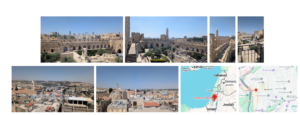 Despite its title, the site was NOT originally built by King David. Old King Dave (my namesake), in fact, lived over 1,000 years before the original citadel was built and had no hand in the construction. Rather, the driving force behind the Tower of David enclave was none other than King Herod the Great, the same guy who built Masada by the Dead Sea.
Back in the first century BC, obsessed with both burnishing his fame as a builder AND fortifying his position before his Roman overlords, King Herod set about constructing a massive fortress at Jerusalem’s western gate. With its commanding vantage point, the fort would grant its defenders control over the surrounding area and, of course, advertise Herod’s eternal greatness.
Over the years, the Tower of David has gained larger and larger historical significance.
Many biblical scholars, for example, believe the Tower might very well be the site of the Praetorium, where Pontius Pilate tried Jesus of Nazareth at the behest of the Jewish leadership and condemned Him to crucifixion.
If you were an invading army coming to Jerusalem over the next 2,000 years, chances are your first order of business would be to take over (and leave your mark on) the Tower of David. That list of “conquerors” includes Romans, Byzantines, Arab Muslims, Crusaders, Mamluks, Turks, the British Empire and finally, Israel.
A side note: the “tower” mentioned in the title of the complex refers not to the original Herodian tower in the northeast of the citadel, but to the 17th-century minaret at the opposite side of the citadel. Since 1967, “Tower of David” officially refers to the entire citadel.
Visting the Tower of David is a splendid, enriching experience – not only for its well-preserved ruins, but perhaps mores so for the dazzling audio-visual displays featured inside its 10 distinct galleries. Thanks to a massive $50 million renovation, the ancient citadel now functions as an amazingly-cool, multi-sensory, storytelling ecosystem.
In the first gallery, for instance, you find a series of imposing, 10-foot touch screens representing different eras in the site’s history. Place your palm on the appropriate spot and up pops an entertaining, animated video of relating the events of that era, mapped to a timeline of what was happening in the rest of the world at the time..
In subsequent galleries you might discover:
The Multi-Faith Custom Soundscape: An immersive audio installation that fills the galleries with chants, prayers, and sound rhythms tracking Judaism, Christianity, and Islam across the city’s timeline.
The Digital Fresco Vault: Thousands of historical digital images are sequentially mapped across a medieval vaulted stone ceiling, creating a moving historical tapestry.
The 19th-Century Digital Model: A famous 1873 hand-crafted zinc model of Jerusalem by Stefan Illés, revitalized with interactive, multi-layered video projections and historical photography that act as a digital “timeline.”
To top it all off (literally), at the end of your self-guided tour of the Tower of David, you can climb (or elevate) to the top of the walls and look eastward towards the Old City for the best view in town.
I originally intended to make a quick stop at the Tour of David museum—maybe get a little history lesson before lunch. I wound up staying 3 hours and could’ve stayed all day. It’s that interesting.
One might say that I came to conquer the Tower of David but, inevitably, it ended up conquering me.
(One cannot write about Israel in 2026 without considering whether it’s both “safe” and “right” to visit the country. My conclusion after a week in Israel is that yes, it’s safe – at least when an enemy isn’t firing missiles at it. During times of “shooting war,” perhaps you give the region a miss. The rest of the time, life in the country to go back to normal; shops open, people gather in public places…you could be touring any developed, western country. During my time there, it felt perfectly safe. As for the question of “right,” I think it’s best to avoid associating a country’s people with its government policies. I might not always support the Chinese government, for example, but I wouldn’t hesitate to visit the Great Wall. I’d say, if you have an interest in seeing the astonishing historical sights of Israel, don’t let any feelings you might have about the government hold you back.)