
Wow Place #359: Onta Pottery Village, Kyushu, Japan
When choosing a place to travel, nature lovers are likely to seek out a beautiful landscape. If you’re drawn to the ocean, you might well pursue a lovely seascape. And urban aficionados will certainly point themselves in the direction of a dazzling cityscape.
But who, among us, would actively hunt for a world-class “soundscape?”
Look no further, soundscape fans—in 1996, Japan’s Ministry of the Environment created a national list of “The 100 Soundscapes of Japan.” The goal was to combat noise pollution by designating 100 iconic natural, cultural, and industrial sounds representing communities across all 47 prefectures.
The selections are divided into three categories: 1) Sounds of Nature; 2) Sounds of Living Things; 3) Sounds of Daily Life and Culture. In the first category you would find the Bamboo Forest in Kyoto or Nachi Falls in Wakayama Prefecture. In the second category, you find the Cicadas of Yamadera Temple in Yamagata Prefecture or the Deer of Nara Prefecture. In the third category is the Bell of the Sapporo Clock Tower in Hokkaido or the Isobue whistling of female divers (Ama) in Ise-Shima (Mie Prefecture).
If I ever win the lottery, I would happily travel the length and width of the country, dropping in on ALL of Japan’s brilliant soundscape locations. But as it is, I only have time on a recent trip to Kyushu (the second-largest of Japan’s four major islands) to visit ONE of these sites.
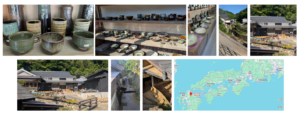
That location is Onta Pottery Village, tucked into the mountains roughly half way between Fukuoka and Beppu. Designated as an “Important National Intangible Cultural Property,” Onta has been creating pottery since 1705. It’s a lovely little town with a very interesting sound.
So what kind of noise does a pottery town produce? Surprisingly, it’s the rhythmic “Thump, thump, thump” of a water-powered hammer, called a “karausa.” Let me explain.
Running directly through the center of town is a narrow, steeply-pitched river. As you walk along the banks, you notice a series of wooden sluices (or mills) mounted on a kind of seesaw contraption, jutting out from the back of the potteries. As the “karausa” fills with water from a side channel of the river, it dips down towards the creek. When it reaches its nadir, the “hammer” dumps out its water, causing its river side to rise rapidly and its back side to drop precipitously into a clay deposit.
In other words, the collecting and dumping of water on the river side causes clay to be hammered on the opposite side, dissolving the material into a fine powder that will eventually be used for pottery making.
Interestingly, there are only ten families in Onta producing pottery. As a result, the “thumping” of the karausa is fairly subtle; this is clearly a very small-scale pottery operation.
It should also be noted that Onta pottery is not particularly flashy or refined. Known for its rustic charm and warmth, Onta “yaki” –with its simple, geometric patterns — has become beloved as practical tableware for everyday use.
How apt is that. Like its pottery, Onta is an unassuming town with an exceedingly unassuming “soundscape.” Less of a WOW and more of a wow. Now shhhhhh! Listen!
(One of my favorite meditation teachers once suggested that before turning attention to my body or my breath, I should first just sit and listen. What am I hearing? Street noise? Electrical humming? My cat snoring? I really enjoy this practice, not only because it centers me in the present, but also because it reminds me to use my sometimes-neglected aural senses.
What if you made this a habit as well? The next time you arrive in a new place, whether urban or natural, close your eyes and notice what you hear. Are there birds about? Or insects? Or jack hammers? If you’re lucky, you’ll find that perfect place where you hear nothing at all! Call in the ultimate Soundscape — #101 on the list!)
(Dave Blum is the creator of Dr. Clue Treasure Hunts, www.drclue.com, a teambuilding company featuring over 150 treasure hunt locations worldwide. He has visited over 40 countries in his 60+ years of life and plans to keep traveling until he gives up the ghost. Dave lives in Northern California with his wife, Donica, and their now 20-year-old Maine Coon, Ava — an indoor cat who dreams of one day escaping captivity and exploring her own neighborhood Wow Places.)
.