
Wow Place #363: Sengen-an Cat Temple, Kagoshima, Japan.
Growing up with a toy poodle (named Candy), I’ve always been in the dog camp when it comes to pet preference. And then, twenty years ago, along came Ava the cat. Half Maine Coon, half Tabby, Ava is a long-haired, strong-willed bundle of piss and vinegar. And I’m crazy about her.
Who would’ve thought that a cat could steal my dog-fancying heart?
Apparently cat-adoration is not restricted to North America. In Ancient Egypt, cats were viewed as divine and magical manifestations associated with fertility. In Turkey, many neighborhoods treat cats as beloved community members, encouraging them to roam freely in shops, cafes and even mosques. In Russia, a working cat “army” has patrolled the Hermitage Museum since the 18th century, guarding the art collection from rodents.
And in Japan, cats are widely thought to represent good luck, fortune and protection, famously embodied by the Maneki-neko (beckoning cat).
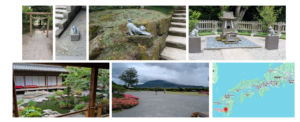
At Kagoshima Prefecture’s Nekogami Jinja, however, cats are celebrated for a very different (and unusual) purpose: timekeeping. The story goes like this:
In the late 16th century, feudal lord Shimazu Yoshihiro brought seven cats with him during his military campaign in Korea. He told the time by observing how the cats’ pupils dilated and narrowed into slits depending on the sunlight.
Sadly, only two of the seven cats survived the campaign and made it back home to Kagoshima. Yoshihiro promptly built a shrine to the celebrated felines in 1602, honoring them as deities. The shrine was eventually relocated to the marvelous Sengan-en estate, where it has morphed into a revered site for local watch and clockmakers.
The message is clear: it’s time for all of us to start treating our cats as purr-fect Gods—as, of course, they’ve been encouraging us to do for millennia. At least my Ava has.
Built in 1658 by the powerful Shimazu clan, Sengen-an is a stunning, 12-acre estate famous for using Kagoshima Bay and the very-active Sakurajima volcano as “borrowed scenery.” The term “Borrowed Scenery” (“shakkei”) is the concept of integrating the landscape outside of the garden into the design of the garden. Both natural objects such as mountains and hills and man-made structures such as castles and buildings can be used as borrowed scenery. In modern times, skyscrapers have become an unintentional (and sometimes intentional) borrowed scenery element for many gardens in the larger Japanese cities.
While walking around Sengen-an, you certainly can’t miss Sakurajima. With its perfect, Fuji-like cone, it is one of Japan’s most active volcanoes, experiencing frequent minor-to-moderate eruptions every year. In other words, for Kagoshima residents, if it’s Tuesday it must be Ash Day.
Apart from the nearby volcano, Sengen-an is a rather lovely garden to explore. The grounds feature traditional ponds, winding streams, small shrines, a grove of giant moso bamboo, and seasonal cherry blossoms. It also features the stunning Iso Residence, a 19th century wooden mansion reflecting the refined 19th-century lifestyle of the Shimazu lords. Its architecture blends Japanese, Chinese, and Western influences.
For me, however, I’ve come here for the cat temple. Rather than live felines, the shrine path features a variety of life-size stone cat sculptures and guardian koma-neko. The two celebrated cat deities sit on parallel stone plinths, guarding the main shrine. Needless to say, cat souvenirs are widely available at the gift shop nearby, including cat-illustrated ema (wooden votive plaques) which you can use to pray for your pets’ health or to honor deceased companions. Special cat-themed goshuin (shrine stamps) and charms are also available.
Are you a cat lover, too? Why not join me one day at Nekogami Jinja for the Cat Longevity Prayer Festival every February 22nd (Japan’s Cat Day) or for the Time Day ceremony on June 10.
What can I say? The meows have it. Cats rule!
(What a marvelous, unconventional idea it is, using cats for timekeeping. It’s kind of the ultimate in re-purposing: giving something a new use or function that is different from what it was originally intended for. Not that any cat I know would ever admit it has a use or function. In their opinion, cats have only one role: be the boss of the household. Nevertheless, I do like the idea of finding new ways to utilize ordinary things. A glass jar becomes a candle holder. An old wooden ladder becomes a bookshelf. An abandoned factory becomes an entertainment venue. Repurposing allows us to reduce waste and keep stuff out of landfills. It saves money by avoiding the needs to buys something brand new. It encourages creative and inventive solutions for everyday items.
When cats eventually take over the world (as many speculate they already have), I wonder how they might repurpose us humans???)