
Wow Place #360: Ukiha Inari Shrine, Kyushu, Japan
The Japanese word “hyouban” translates roughly to “fame, reputation or popularity” as well as “rumor or talk.”
If you visit Japan, no doubt the hyouban of certain sites will precede them.
Mt. Fuji has a reputation as the most beautiful mountain in the country. Himeji is widely considered the nation’s greatest castle. And Fushimi Inari Taisha, with its 5,000 torii gates, is the sight every tourist wants to see in Kyoto.
But are hyoubans always accurate?
In the case of the locations above, yes, the reputations absolutely hold true. All three are spectacular, not-to-be-missed sites.
But along with a hyouban inevitably comes mobs and mobs of tourists, especially at Fushimi Inari shrine. If you don’t arrive there by 6am (or earlier), a walk up the hillside through the gorgeous, red-gate tunnel will be like taking an escalator at Heathrow airport during high travel season. Don’t expect a serene, solitary experience with an abundance of elbow room!
That’s why I much prefer Ukiha Inari Shrine in Kyushu, about an hour by car from Fukuoka.
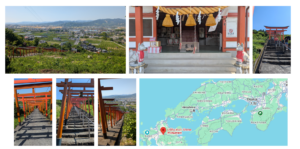
Like its cousin in Kyoto, Ukiha is an “Inari” shrine. That means it’s dedicated to Inari Ikami, the Japanese god or spirit of rice, agriculture, commerce, industry and general prosperity.
Also like Fushimi Inari Shrine, Ukiha is characterized by a series of bright, orange-red torii gates, lined up in a dense, continuous tunnel.
But unlike its Kyoto cousin, Ukiha is virtually devoid of tourists. While we were there, my buddy Cenzo and I saw at most three other people, and they were locals, not foreigners.
Built in 1957, the shrine is known for its blessings of prosperity in business, good harvest, sake production and health, longevity, and academics. Located on the top of a mountain, Ukiha Inari boasts a waterfall of torii cascading down the hillside, heading first straight, then left, then bending right. That’s 92 torii gates and 300 steps, all affording a stunning view of the town of Ukiha and the area’s rolling green hills and rice paddies in the background.
If the air is clear, you can even see as far as Fukuoka City in the distance.
The shrine does, however, throw a sucker punch. When we arrive at Ukiha Inara, it appears evident that we should park our car at the bottom of the torii tunnel and walk up the nearly-100 steps to visit the shrine. That’s what the other tourists are doing.
It’s a hot, sweaty walk to the top of the stairs on uneven, rocky steps. When we finally arrive at the summit, exhilarated but fairly exhausted, we notice a path to the right leading to the shrine’s parking lot! The guidebook never mentioned we could have driven to the top and spared ourselves the climb.
I guess that’s what happens when someplace doesn’t have a hyouban; it may not come with a crowd-sourced instruction manual either!
(The thing about reputations is that the object, person or location rarely lives up to the hype. How many times have you rushed to a highly-touted restaurant, only to discover that the food is pretty meh? Or a house painter comes to you with pages of testimonials and then proceeds to paint your walls the wrong color! Reputations are tricky. They create an expectation of competence, superiority and trustworthiness. In the end, you have to judge everything by your own experience, with the faith that the reputation (and the often-heavy price tag) is appropriate. Do your research and trust your gut!)