
Wow Place #362: Ikemeguri Nature Trail, Kirishima-Kinkowan Park, Kyushu, Japan
I hate backtracking. If there’s even a possibility of making a circular loop around an area (rather than a straight out-and-back), I’m going to take that route. There’s nothing I dislike more than being told, half way to my destination, “Sorry, the road’s closed, you need to return the way you came.”
Backtracking, of course, happens all the time—in traveling and in life—and it frustrates the heck out of me. It’s so inefficient!
Once for example, on a trek in Nepal, I and a group of fellow hikers came across a perilous landslide that had washed out our trail. Oh, there was a makeshift path on top of the landslide, but it was VERY dangerous. One bad step and we’d be sliding down the hillside into the far-off river, hundreds of feet down below. Faced with the dilemma, continuing across the landslide or turning around and heading back home, we all decided to work together and brave the passage. Hand-in-hand, we sidled along the trail, ready to save any of our companions who happened to lose their footing. The alternative, turning around, seemed riskier (emotionally) than braving the pass. (Happily, we all survived, although it was definitely gnarly.)
On a recent trip to the Kirishima-Kinkowan Park in southern Kyushu, Japan, my buddy, Cenzo, and I find ourselves faced with a similar, backtracking conundrum.
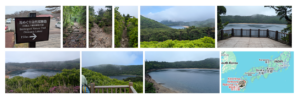
At the beginning of the lovely Ikemeguri Nature Trail, a path that circles three scenic, volcanic lakes, we are told at the visitor’s center that the final stretch is closed due to sulfurous, volcanic gases. We are assured that it is impassible and we’llhave to return the way we came, even though the forbidden stretch is only 10-15 minutes in length.
“Yeah, right. How bad could a little sulfur be, right? Let’s give it a go!”
Straddling Kagoshima and Miyazaki Prefectures and quite off the beaten path, Kirishima-Kinkowan is a stunning national park rarely-visited by foreign tourists. Boasting over 20 volcanos, the park is dotted with crater lakes, hot springs, and lava plateaus — well worth a visit! The Ikemeguri (literally “Pond Hopping”) Nature Trail is my favorite of the hikes we did: two gentle hours of rolling hills and vibrant-green tropical plants, punctuated with bright-pink azaleas that characterize the late springtime flora in southern Kyushu. Each of the lakes – Lake Byakushiike, Lake Rokkannon Miike and Lake Fudoike – has its own distinctive character.
Best of all along the trail are the interesting landmarks you encounter, like: 1) a 550-year-old giant cedar, believed to have been planted by the followers of Rokkannon. And 2) The Rokkannon-do shrine, whose interesting story goes as follows:
“During the Shoku era, a high monk was reading aloud the Lotus Sutra by the side of the lake when all of a sudden, a gray-haired old man appeared and said, ‘I am Yamato Takeru no Mikoto. It has been a long time since I have become a swan and taken up residence on this mountain. Now I reveal myself to you in response to the virtue of your ascetic recitation.’ In response, the monk went on to build the hall on the lakeside spot where the old man appeared, where he enshrined a hand-carving of Rokkannon.”
Japanese hiking trails tend to be like this: small plaques and shrines greet you along the way, telling enchanting stories of myth, magic and wandering spirits – all of which the locals ardently believe in (or so they tell me.)
Anyway, after nearly 2 hours of hiking, we come at last to the “forbidden area.” Yellow emergency tape spanning the path, a sign in both English and Japanese commands us, in no uncertain terms, to turn around. “Beware dangerous volcanic gases!”
What to do? The air doesn’t smell that bad here. Turning around will add at least another 90 minutes to our hike. There’s no one around. Surely we can sneak under the tape, hold a handkerchief to our mouths, and complete the circuit, right?
And yet, what is the air really IS that dangerous? Neither of us know the actual dangers of such gases. 5,000 miles from home, the last thing we want is to be medevac-ed out the area!
And yet—backtracking. Yuck!
In the end, perhaps because we’re prudent 60-year-olds now rather than devil-may-care 20 somethings who believe they’re immortal, we grudgingly decide to turn around and retrace our steps. After all, the trail is just as pretty on the way back. And we can bring even more photos – and clear lungs—back home with us.
(Efficiency is an alluring concept, isn’t it? Who doesn’t have an app on their phone that promises to help us get our lives supremely stream-lined and organized. When my wife and I are in the kitchen and we succeed in banging out a new recipe with minimal waste of time and effort – working together as a lean, mean, cooking machine—we feel highly satisfied. High fives are called for. And yet—are we all not perhaps a little too efficient at times? When we allow ourselves to be inefficient, we’re released from the stress of optimization. Space arises for rest, creativity and genuine connection. Rather than giving in to our culture’s obsession with maximizing every minute, perhaps it’s worth considering slowing down rather than speeding up – choosing the imperfect way to doing something. It’s a radical thought that might just save you from a boatload of stress – not to mention a lungful of volcanic gas.)